
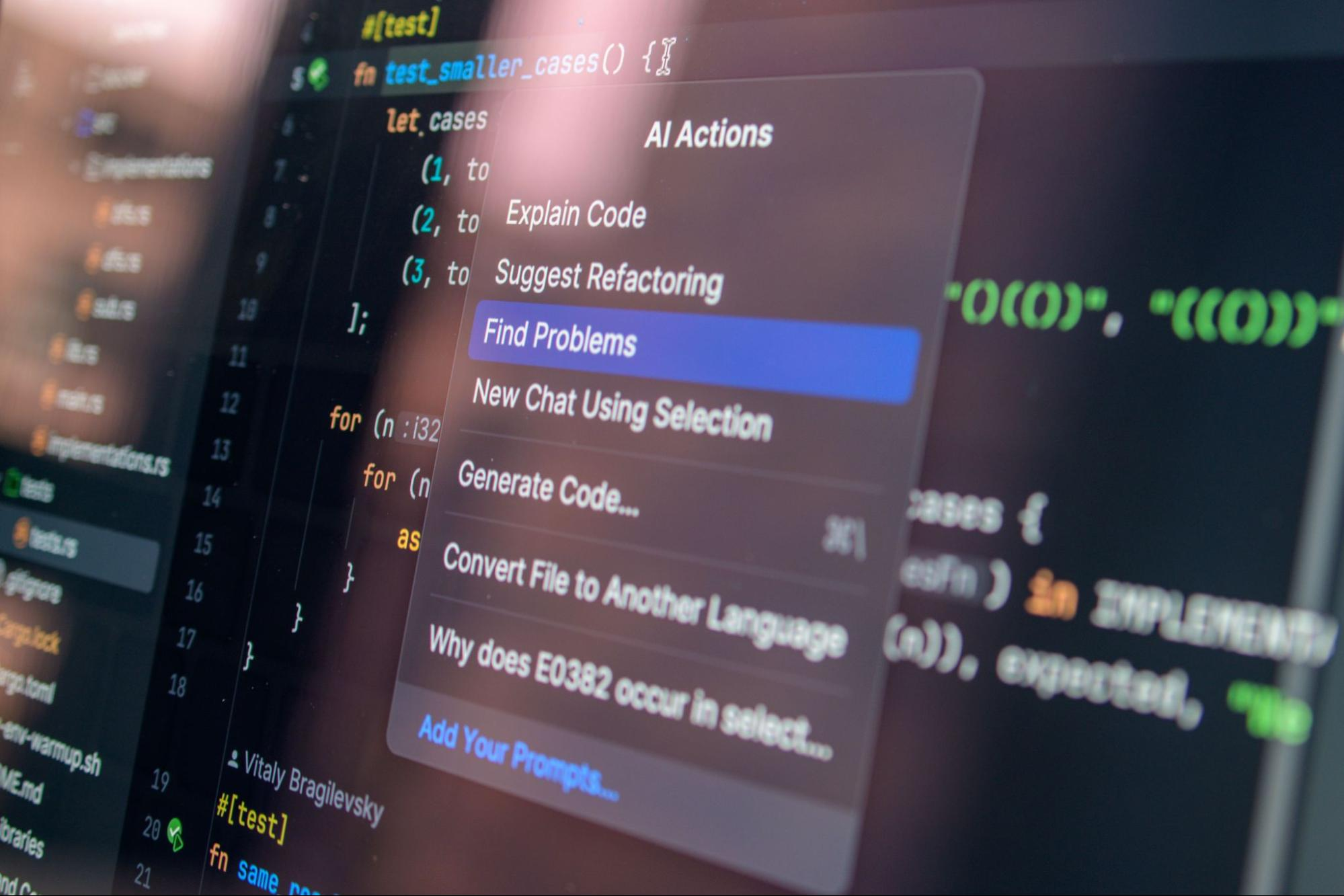

AI has quickly become a fixture in software development, but the numbers tell a more complicated story. Generative AI coding statistics show widespread adoption alongside ongoing questions about productivity, code quality, and developer trust.
At Modularis, we’ve compiled seven key statistics and trends showing how developers are using AI in 2026, from AI-assisted coding and the rise of coding agents to productivity gains and the challenges that come with them.
3 Easy Steps to Make Modularis Your Trusted Partner
Our on-boarding process engages your entire organization in a staged process that aligns technical milestones with your business objectives. Learn what you need to get started today!
Research Methodologies and Notes
At Modularis, we’ve been in software development for more than 20 years, so we feel that we have the authority to speak on this topic.
That said, we wanted to prevent bias, so we did lots of external research to prepare this piece.
In our research for this report, we wanted to provide a snapshot of how developers are using artificial intelligence today and what sort of business impact this is having. For this, we looked at primary sources such as self-reported developer surveys, system telemetry paired with self-reported data from a developer intelligence platform, and randomized controlled trials.
For research on business impact, we looked at direct company and analyst disclosures for revenue, user counts, and market forecasts.
Full citations, with links to the original report, survey page, or announcement rather than secondhand coverage, appear in the sources list at the end of this page.
These sources differ substantially in scale and method. For example, the cited surveys range from a few hundred to tens of thousands of respondents, self-selected from each publisher’s own developer audience rather than drawn from a representative sample of the field.
Additionally, we analyzed Reddit threads and online developer communities to get an idea of what developers are saying about each of these trends.
Our research findings and analysis of generative AI coding statistics and trends are summarized below.
1. About 79% of developers use AI tools, but sentiment and trust in the output are dropping1, 2, 3
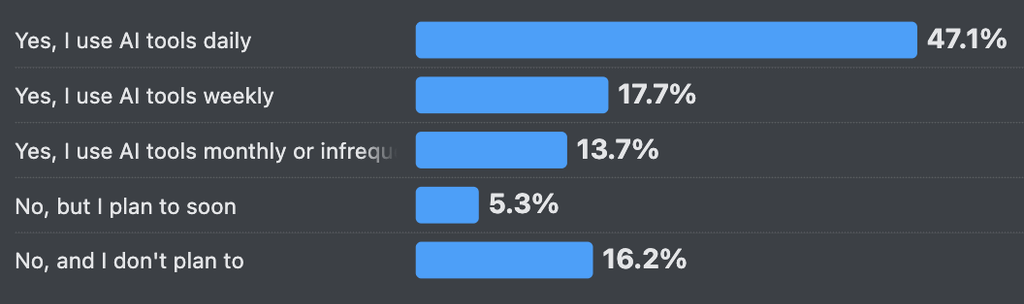
Stack Overflow’s 2025 survey found that 84% of developers use or plan to use AI tools, up from 76% the previous year. This includes developers who do not currently use AI tools but plan to soon. But developer trust in AI tools is decreasing.
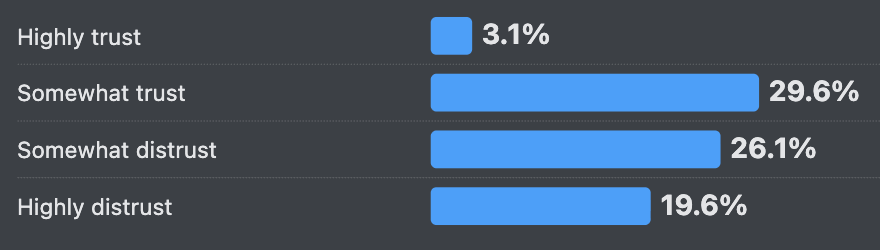
About 46% of developers at least somewhat distrust AI-generated results, an increase from 31% in 2024.
And while 33% of developers at least somewhat trust AI, only about 3% highly trust it.
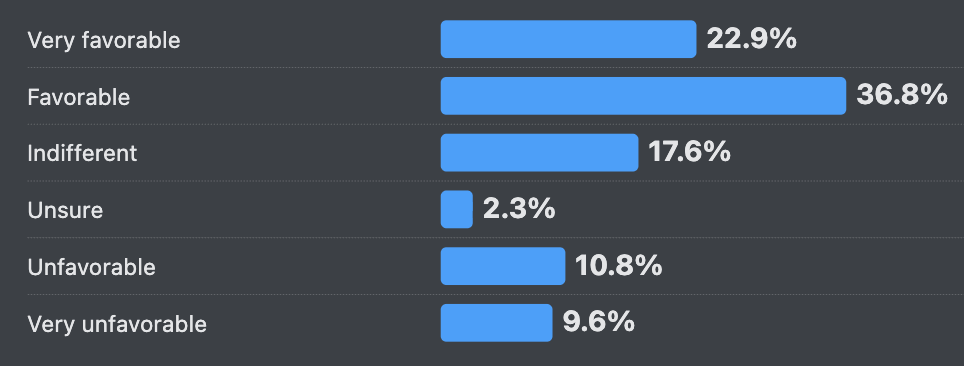
Positive sentiment toward AI tools also dropped from more than 70% in 2023 and 2024 to about 60% in 2025. Only 22.9% of respondents had a very favorable opinion of AI, while 9.6% reported a very unfavorable opinion.
Among respondents, the biggest frustration with AI tools was solutions that were almost right but not quite, cited by 66% of developers. Another 45% said debugging AI-generated code took longer than expected, and 20% said they’ve become less confident in their own problem-solving.
Even in a future where AI handles most coding tasks, developers still see a need for human help. About 75% of respondents said they would want a human involved if they did not trust AI’s answers.
Stack Overflow’s researchers called the trend of decreasing trust in AI tools counterintuitive: typical technology adoption curves show trust rising alongside familiarity, but with AI coding tools the opposite has happened.
Their read is that software engineers are trained for deterministic thinking, expecting the same input to produce the same output every time, which clashes with the probabilistic nature of generated code.
CodeRabbit’s December 2025 review4 of merged pull requests found that AI-coauthored code carries roughly 1.7 times more issues and security findings than human-written code.
Sonar’s October 2025 survey5 adds a related wrinkle. Of development teams they surveyed, only 55% rated it extremely or very effective for new code development.
A similar gap appears in refactoring and optimization work, with 72% of respondents using AI tools for these tasks but only 43% finding them effective.
The pattern of rising usage paired with falling trust is consistent across nearly every independent 2026 survey. Developers keep the tools running but stay in the loop on review, testing, and final judgment calls, particularly for anything touching security vulnerabilities or system integration work.
2. More than 90% of engineering organizations now use AI for coding6, 7, 8, 9
DX’s Q2 2026 AI Impact Report shows that more than 9 in 10 engineering organizations now use AI in their development work.
AI is also playing a much larger role in the code developers produce. Of all the code merged by the organizations in DX’s sample, nearly 30% was written by AI.
But greater AI use is also creating new challenges. The average pull request has grown from 42 lines in Q3 2025 to 72 lines, which DX links to growing concerns about code review and quality.
Other surveys show a similar trend. The previously mentioned Stack Overflow survey1 found that 51% of professional developers were using AI tools daily in 2025, while about 47% of all respondents reported the same. Developers who were earlier in their career were more likely to use AI.
AI adoption is no longer the question. Developers are already using it at scale. The bigger questions are how much AI is improving productivity, whether the code it produces maintains quality, and whether developers are actually saving time once review and debugging are factored in.
3. Claude Code is currently the most-used AI coding tool10
GitHub Copilot was the first AI coding tool to reach mass adoption. Microsoft12 reported that Copilot had more than 20 million users by mid-2025. By early 2026, it had 4.7 million paid subscribers, up about 75% from the previous year.13
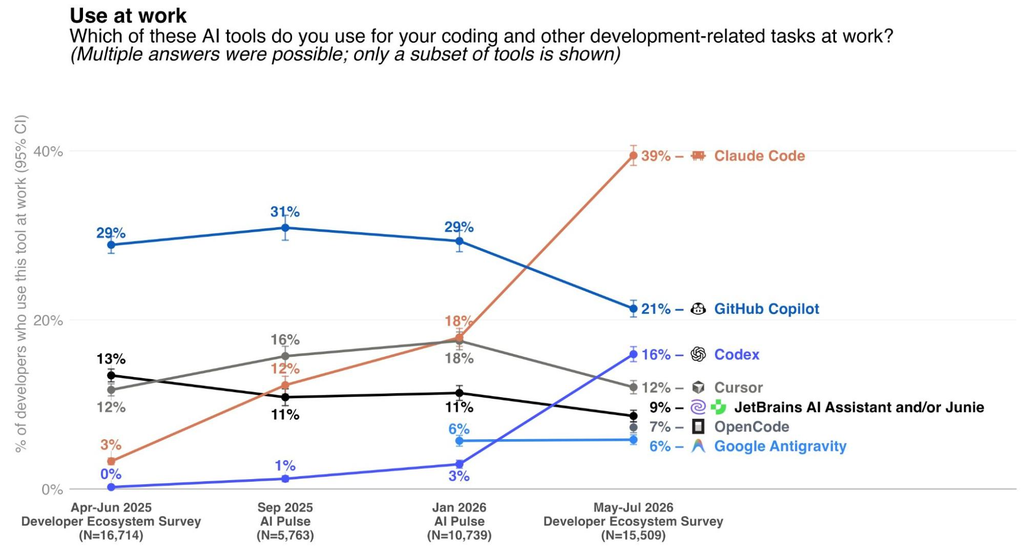
But Copilot is losing ground in daily use. JetBrains found that its active adoption fell from 29% to 21% between 2025 and 2026, even though 79% of developers still recognize the brand.
Claude Code has now taken the lead. JetBrains found that 39% of professional developers were actively using Claude Code by mid-2026, up from 18% in January, more than doubling over that period. In the U.S., adoption reached 47%.
Developers also appear to prefer Claude Code over its competitors. In The Pragmatic Engineer’s survey, 46% named Claude Code their favorite AI coding tool. Cursor came in at 19%, while Copilot reached just 9%.14
Claude Code’s business growth has been just as significant. Anthropic reported in February 2026 that its annualized revenue run rate had more than doubled since the start of the year, surpassing $2.5 billion.15
Claude Code isn’t the only tool gaining ground. OpenAI’s Codex grew from 3% adoption in January to 16% by mid-2026.
The AI coding market is changing quickly, with developers increasingly moving beyond Copilot to newer tools.
4. Coding agents are becoming the main way developers use AI6, 7, 8, 9
For years, AI coding assistants were mainly used for autocomplete and code suggestions.
That is changing. Coding agents can now handle much more of the development process. They can understand a task, find the relevant files, write the code, run tests, fix problems, and report the results with much less step-by-step guidance.
DX’s Q1 2026 report shows that this shift is affecting entire engineering teams, not just individual developers.
Engineering managers who used AI daily shipped about four times as much code as managers who did not. AI is also helping other teams work with engineering. About 75% of designers and product managers used AI coding tools to speed up handoffs to developers.
New engineers are also getting up to speed faster. DX found that it took an average of 33 days for new engineers to merge their first 10 pull requests in Q4 2025, compared with 39 days in the previous quarter.
But the productivity gains come with some concerns. As we’ve mentioned, nearly 30% of merged code was AI-generated in Q1 2026, but some teams saw defect rates increase by up to 50%.
5. AI usage jumped 65% in just over a year, but productivity increased less than 8%7
DX’s longitudinal study tracked pull request throughput from November 2024 to February 2026 across more than 400 companies.
Over that period, as AI tool usage rose by an average of 65%, median pull request throughput rose by just 7.76%. Most organizations land in a 5 to 15% range, well short of the 3x to 10x figures common in vendor marketing.
DX attributes the gap partly to the fact that coding was never the entire job: meetings, code review, and deployment waits absorb much of the time AI frees up.
Separately, DX’s Q4 2025 report, covering data collected in the final months of 2025 and drawing on more than 135,000 developers across 425 organizations, found an average time savings of 3.6 hours per developer per week, with daily AI users shipping 60% more pull requests than non-users, and 22% of merged code AI-authored at the time.
6. Experienced developers took 19% longer to complete tasks with AI11
Survey data captures how developers feel about AI tools, not whether the tools actually make them faster. A randomized controlled trial from METR is the most direct evidence on that.
Sixteen experienced open-source developers worked on 246 real issues in mature repositories they were familiar with between February and June 2025, with each task randomly assigned to allow or disallow AI tools, mainly Cursor Pro with Claude 3.5 or 3.7 Sonnet.
Developers predicted AI would cut their completion time by 24% and still believed it had made them 20% faster afterward.
However, the measured result went the other way: tasks took 19% longer when AI was allowed. METR describes this as a snapshot of AI capability in that period, not a permanent verdict.
The gap between felt speed and measured speed here mirrors the DX data we mentioned in the previous section: a 65% rise in AI tool usage but only an 8% increase in measured throughput.7
As AI platforms become better at writing code, this will change.
7. AI-assisted code is contributing to a growing technical debt problem16,17,19
AI can make it easier to produce code quickly, but that speed can come with a longer-term cost: technical debt. This refers to future rework and maintenance burden created when teams prioritize short-term solutions over cleaner, more sustainable code.
GitClear’s 2025 AI Copilot Code Quality research analyzed 211 million changed lines of code from 2020 through 2024. The research found several indicators that code quality is deteriorating as AI-assisted development becomes more common.
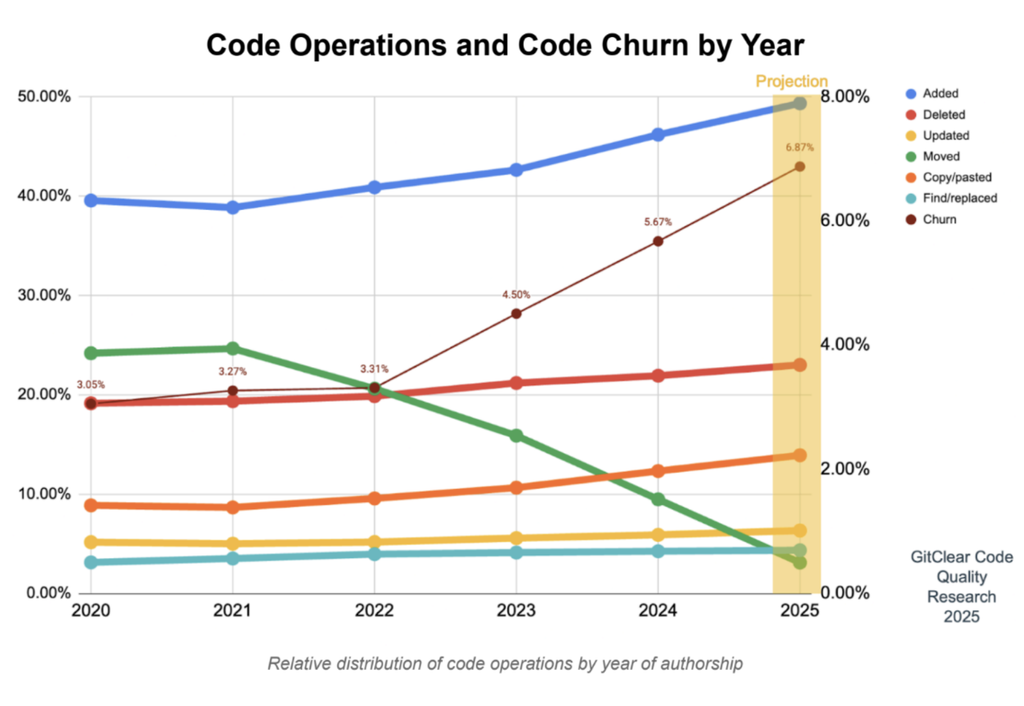
One of the clearest signals is the decline in refactoring. The share of changed lines associated with refactoring decreased from 25% in 2021 to less than 10% in 2024. During the same period, cloned or copy-pasted code increased from 8.3% to 12.3%.
GitClear also found that the frequency of code blocks containing five or more lines duplicated from adjacent code increased eightfold in 2024, making code duplication roughly 10 times more prevalent than two years earlier.
Less refactoring and more duplication can leave developers with increasingly fragmented codebases, where the same logic must be maintained in multiple places and developers spend more time working around existing code rather than improving it.
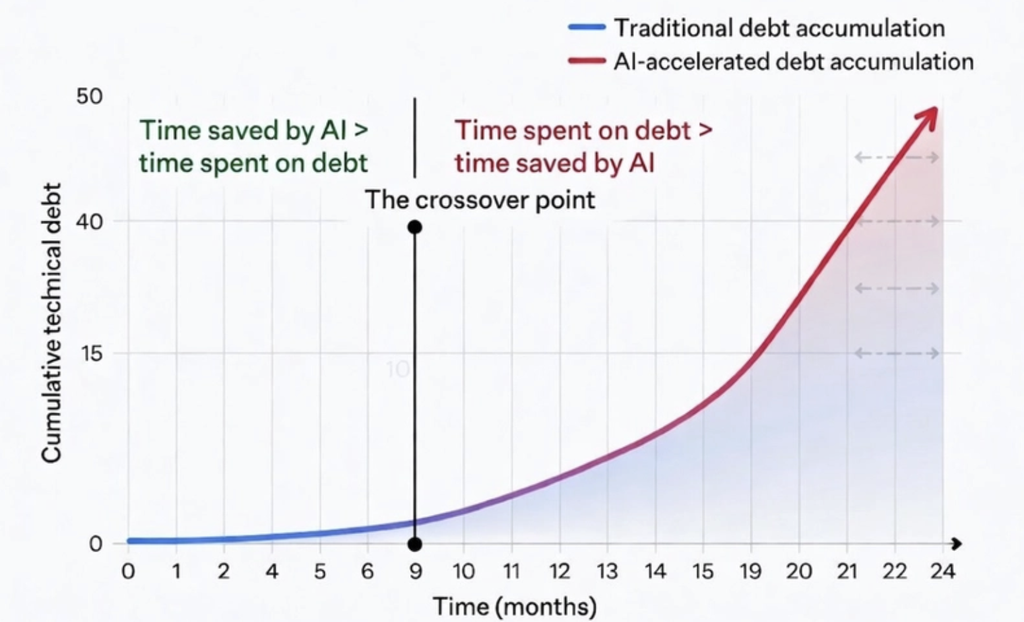
While AI-assisted coding can help developers complete tasks faster, they often have to spend more time later debugging, testing, refactoring, and fixing vulnerabilities in code.
Other research points to a similar trade-off. Google’s 2024 DORA report found that a 25% increase in AI adoption was associated with faster code reviews and improvements in documentation, but also a 7.2% decrease in delivery stability.18
The concern is not that AI-generated code is inherently poor. Rather, AI makes it cheap and easy to add more code, while developers remain responsible for understanding the broader architecture and deciding when code should be reused, consolidated, or refactored. Without time devoted to that work, today’s productivity gains can become tomorrow’s maintenance burden.
For engineering teams, the challenge is therefore not simply generating more code with AI, but ensuring that the codebase remains maintainable as AI increases the volume and speed of development.
What These Generative AI Coding Statistics Reveal
The gap between promised and measured AI gains remains the open question. Adoption has crossed from majority to near-universal, and the way developers work day to day has shifted toward directing AI agents rather than typing every line by hand.
At the same time, the productivity gains measured by available studies are smaller than vendor marketing suggests. Trust has fallen even as usage has climbed, and the organizations reporting the clearest gains are the ones treating AI adoption as something to measure and manage rather than something to simply switch on.
The gap between AI’s promised productivity multiplier and its measured one remains the central open question for engineering leaders going into the back half of 2026.
How Modularis Helps Teams Build With AI
AI coding tools are changing how developers write, test, and deploy software. Modularis takes this approach into IoT development with PlatformBuilder, a modular AI code generation platform designed for complex IoT systems.
PlatformBuilder helps teams generate and test software before hardware is finalized, supporting development from initial code generation through product development and launch. This allows teams to validate software earlier, identify potential problems before deployment, and move from concept to production with less risk.
Teams can use PlatformBuilder for applications such as predictive maintenance, connected production lines, asset tracking, and smart factory monitoring.
By combining AI-assisted code generation with a structured development process, PlatformBuilder can help teams capture the productivity benefits of AI without simply adding more code to an already complex system.
With more than 500,000 IoT devices supported and over $285 million in exit value created, Modularis helps organizations tackle complex IoT software development across manufacturing, energy, healthcare, and other industries.
Learn more about PlatformBuilder or contact Modularis to schedule a demo.
Sources
- Stack Overflow, 2025 Developer Survey: https://survey.stackoverflow.co/2025/ai
- Stack Overflow, 2025 Developer Survey Reveals Trust in AI at an All Time Low: https://stackoverflow.co/company/press/archive/stack-overflow-2025-developer-survey/
- Stack Overflow, Mind the gap: Closing the AI trust gap for developers: https://stackoverflow.blog/2026/02/18/closing-the-developer-ai-trust-gap/
- CodeRabbit, State of AI vs Human Code Generation Report: https://www.coderabbit.ai/whitepapers/state-of-AI-vs-human-code-generation-report
- Sonar, State of Code Developer Survey report 2026: https://www.sonarsource.com/state-of-code-developer-survey-report.pdf
- DX, State of AI Impact in Engineering: Q2 Report: https://getdx.com/report/state-of-ai-impact-in-engineering-q2-report/
- DX, AI and Engineering Velocity: A Longitudinal Analysis: https://getdx.com/report/ai-and-engineering-velocity-a-longitudinal-analysis/
- DX, State of AI Impact in Engineering: Q4 Report: https://getdx.com/report/ai-assisted-engineering-q4-impact-report/
- DX, State of AI Impact in Engineering: Q1 Report: https://getdx.com/report/ai-assisted-engineering-q1-impact-report/
- JetBrains, AI Coding Agents: Adoption Trends: https://blog.jetbrains.com/research/2026/08/ai-coding-agent-adoption-2026/
- METR, Measuring the Impact of Early-2025 AI on Experienced Open-Source Developer Productivity: https://arxiv.org/abs/2507.09089
- Microsoft, FY2025 Q4 earnings conference call: https://www.microsoft.com/en-us/investor/events/fy-2025/earnings-fy-2025-q4
- Microsoft FY 2026 Q2 earnings conference call: https://www.microsoft.com/en-us/investor/events/fy-2026/earnings-fy-2026-q2
- AI Tooling for Software Engineers in 2026: https://newsletter.pragmaticengineer.com/p/ai-tooling-2026
- Anthropic raises $30 billion in Series G funding at $380 billion post-money valuation: https://www.anthropic.com/news/anthropic-raises-30-billion-series-g-funding-380-billion-post-money-valuation
- How AI generated code compounds technical debt: https://leaddev.com/technical-direction/how-ai-generated-code-accelerates-technical-debt
- AI Copilot Code Quality: 2025 Look Back at 12 Months of Data: https://www.gitclear.com/ai_assistant_code_quality_2025_research
- Highlights from the 10th DORA report: https://cloud.google.com/blog/products/devops-sre/announcing-the-2024-dora-report
- The Hidden Cost of AI Coding: Technical Debt You Can’t See: https://dev.to/aws/the-hidden-cost-of-ai-coding-technical-debt-you-cant-see-1767