


IoT in the healthcare industry enables medical practitioners to make appropriate decisions to improve patient care by leveraging internet-connected devices and data analysis. Hospitals, clinics, and healthcare organizations can remotely track patient vitals, manage equipment, and monitor medication adherence.
The healthcare industry is facing workforce shortages, and this issue is projected to continue. NCHWA projects an overall shortage of 141,160 physicians in 2038, and the healthcare industry is looking to IoT technologies to help build efficiencies that can assist in closing the supply and demand gap.
At Modularis, we’ve gathered essential healthcare IoT statistics and trends that provide insight into the industry, benefits, applications, challenges, and use cases for the Internet of Medical Things (IoMT).
3 Easy Steps to Make Modularis Your Trusted Partner
Our on-boarding process engages your entire organization in a staged process that aligns technical milestones with your business objectives. Learn what you need to get started today!

Key Healthcare in IoT Statistics
1. The global IoT in healthcare market is projected to reach $573.13 billion by 2035 1
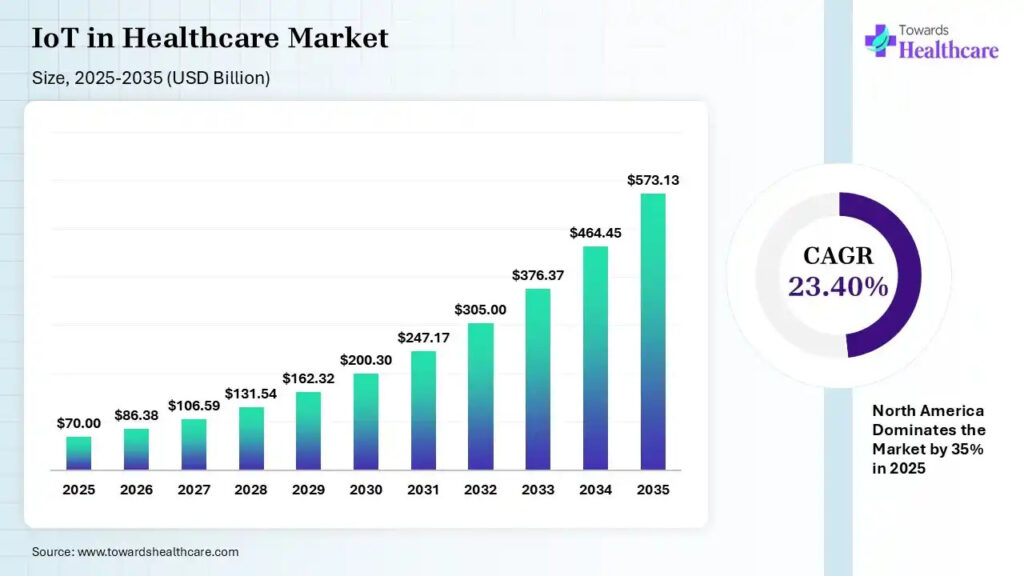
Image Source: Towards Healthcare
The global IoT in Healthcare Market is valued at an estimated USD $86.38 billion in 2026, up from $70 billion in 2025. Over the next 9 years, the industry is expected to grow significantly, reaching $573.13 billion in 2035.
According to the sourced report from Towards Healthcare, this growth is primarily driven by rising healthcare industry costs, an aging population, an increase in chronic diseases, and the increased popularity of remote monitoring.
The report also highlights these benefits of IoT for the healthcare industry:
- Remote patient monitoring makes it possible to collect and transfer real-time health data, enabling continuous care and early intervention.
- Enhanced connectivity allows medical services to facilitate data movement and analysis, automate patient flow, and ensure interoperability among devices.
- Patient-centric diagnostics transform hospital-centric routine check-ups into home-centric evaluations, which can be more convenient and reduce costs.
- Efficiency and cost reduction made possible through IoT improve the efficiency of healthcare systems, equipment monitoring, and resource management.
IoT is growing rapidly in healthcare due to industry professionals looking for ways to reduce costs, improve efficiency, and improve patient care and experience.
2. North America leads the global market with a 35% share in 2025, but the Asia Pacific region is the fastest growing 1
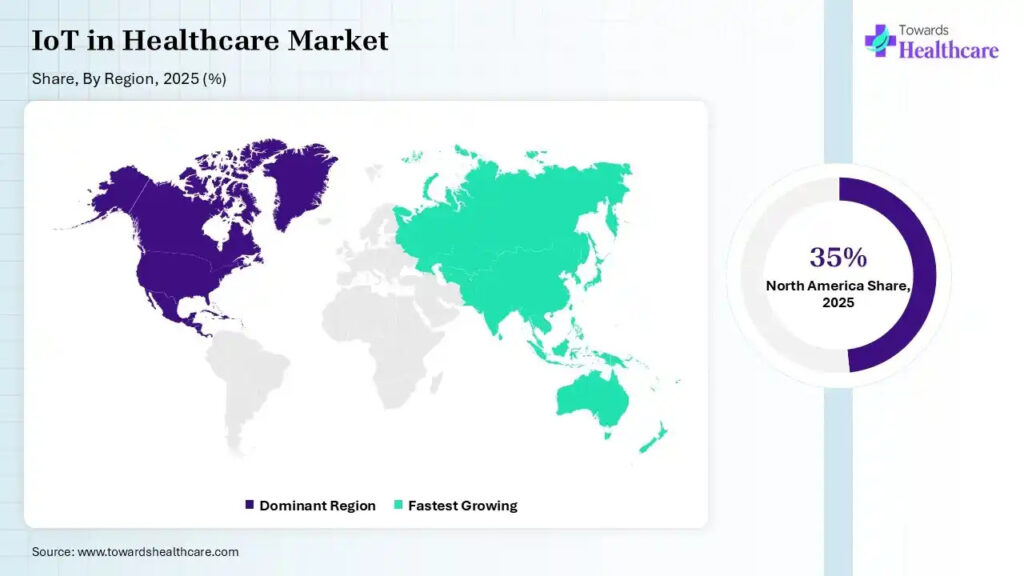
Image Source: Towards Healthcare
North America continues to dominate with a 35% share of the global healthcare IoT market.
Reports point to the U.S. as a significant driver of healthcare IoT innovation due to the vast presence of technology companies, extensive healthcare R&D activities, and a strong focus on digital health care solutions.
Canada demonstrates a strong, growing interest in healthcare IoT technologies, driven in part by the COVID-19 pandemic. The Canadian government is integrating intelligent medical devices into Canadian healthcare systems.
Asia Pacific is the fastest growing region, with an expected compound annual growth rate (CAGR) of 27.9% per year until 2035.1 China is a key contributor to this growth. With its significant investment in healthcare, focus on digital health initiatives and technological innovation, and a massive population, China is a breeding ground for IoT healthcare innovation.
3. The #1 healthcare IoT trend, remote patient monitoring, is driving the global telehealth market to reach $1.4 trillion by 20352
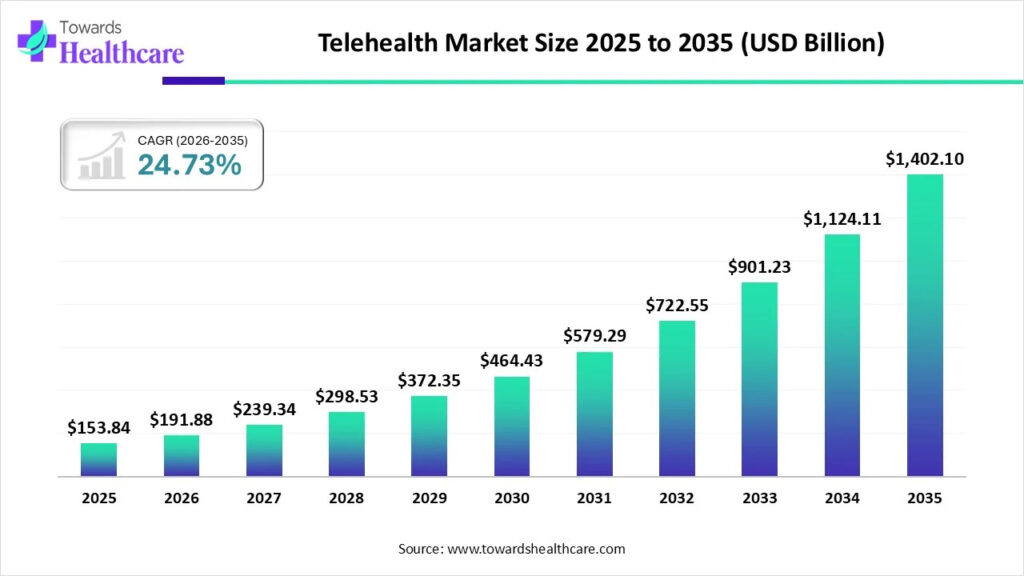
Image Source: Towards Healthcare
Based on the latest data available, the global telehealth market size grew from $153.84 billion in 2025 to $191.88 billion in 2026. This is primarily driven by the rise in chronic conditions and the growing demand for remote patient monitoring.
Ultimately, the global telehealth market is expected to reach $1.4021 trillion by 2035. As remote patient monitoring and telehealth, including telemedicine, continue to become more popular, they will continue to drive growth in demand for healthcare IoT technologies.
Additional Healthcare IoT Statistics
1. About 30% of U.S. adults use wearable health care devices3
Among people who use wearable devices, over 47% use them daily. This includes devices like the Apple Watch or Fitbit to track their fitness progress, steps, and other health metrics.
Those most likely to report using wearable devices such as fitness trackers and smartwatches include college graduates or people with some level of college education, white individuals, adults aged 18-50, people with household incomes over USD $75,000, and women.
2. A majority (82.38%) are willing to share the health data from wearables with their care providers.3
This can be good news for hospitals and healthcare providers looking to help patients remotely. More than 80% of patients are willing to share health data from their personal devices with providers.
3. 22% of healthcare organizations have experienced cyberattacks that directly impacted medical devices4
With the rise of IoT, there is an increase in cybersecurity risks. In fact, 22% of healthcare organizations have had their devices impacted by cyberattacks. These incidents disrupted patient care, including nearly a quarter requiring patient transfers to other facilities.
Additionally, cyberattacks are data security risks, as electronic health records and other personal personal health information can be accessed and exploited by malicious actors. Particularly with laws such as HIPAA that are designed to protect patient data, cybersecurity is foundational for compliance.
4. 53% of networked medical devices have at least one known critical vulnerability5
According to an FBI investigation, more than half of medical devices have at least one known vulnerability. As devices become more connected to the internet, previously shielded medical devices become exposed to cybersecurity vulnerabilities, making it essential for providers to protect patients’ healthcare data.
How Modularis Can Help
Modularis is the maker of PlatformBuilder, a modular AI code generation platform that accelerates serious IoT development.
Whether you’re developing systems for remote patient monitoring, connected medical devices, hospital asset tracking, wearable health technology, or smart healthcare facilities, this PlatformBuilder allows you to build and test software before the hardware is finalized. Avoid costly system failures and catch issues before deployment.
With over 500,000 IoT devices supported and over $285 million in exit value created, we solve the biggest challenges in IoT software development, not only for the healthcare sector but also for IoT in agriculture and other industries. Contact us to schedule a brief demo today.
Sources
- https://www.towardshealthcare.com/insights/iot-in-healthcare-market-size
- https://www.towardshealthcare.com/insights/telehealth-market-sizing
- https://pmc.ncbi.nlm.nih.gov/articles/PMC7600024/
- https://runsafesecurity.com/resources/press-releases/2025-medical-device-cybersecurity-index/
- https://www.aha.org/system/files/media/file/2025/05/2024-fbi-internet-crime-report.pdf