
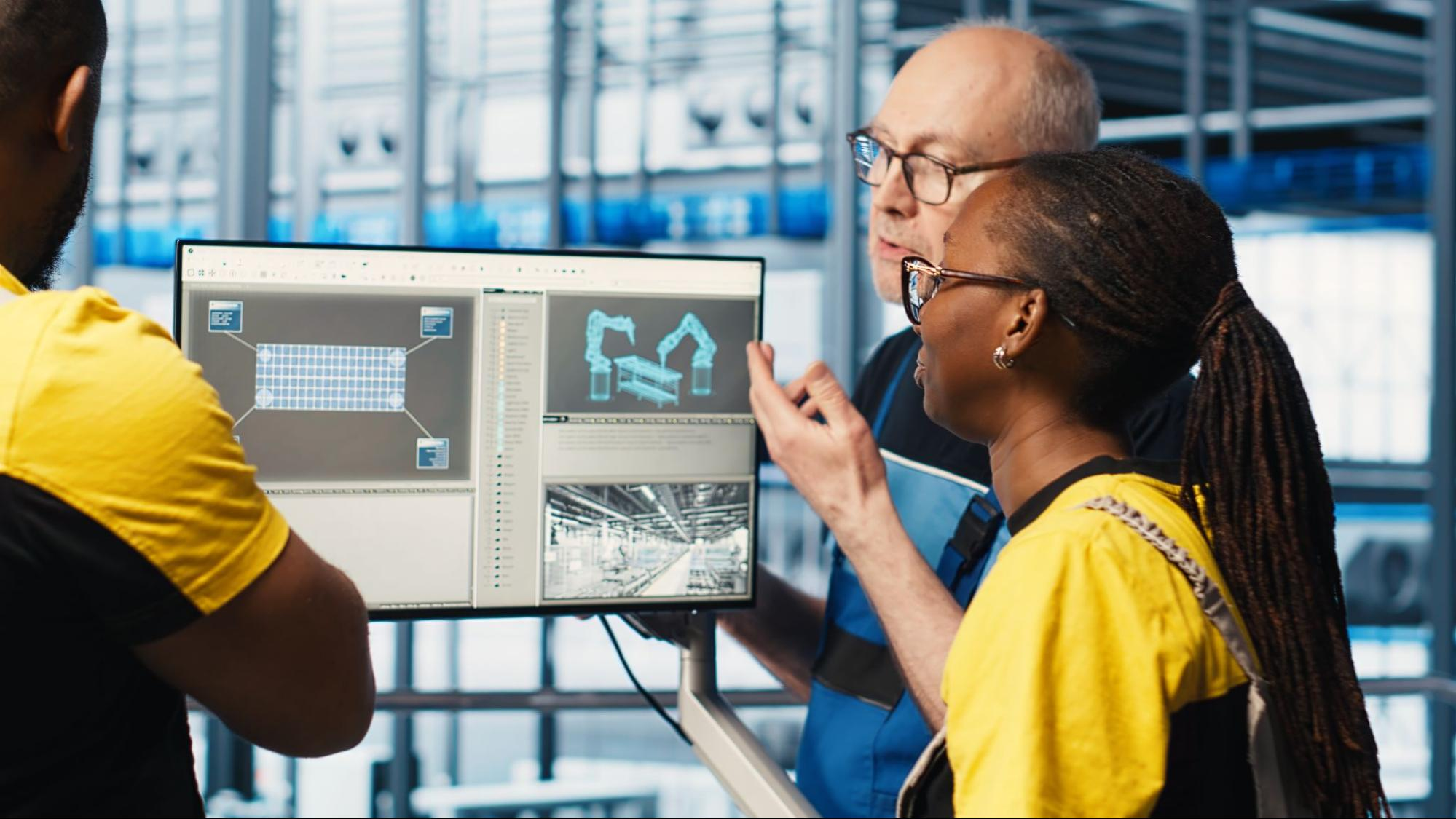

The Internet of Things (IoT) in manufacturing connects sensors, machines, and production systems so operators can perform real-time monitoring of equipment health, track output, and automate decisions across the factory floor.
As a key technology behind Industry 4.0 and industrial automation, IoT helps manufacturers improve machine performance, streamline quality control, and increase operational efficiency through connected data.
Manufacturers use these systems to catch mechanical wear before it causes a breakdown, track assets across the plant floor, and cut waste out of production. Increasingly, IoT also provides real-time data that supports artificial intelligence (AI), predictive analytics, and other smart manufacturing applications.
At Modularis, we’ve gathered 5 key IoT in manufacturing statistics and trends to show how adoption looks today and where the market is headed.
3 Easy Steps to Make Modularis Your Trusted Partner
Our on-boarding process engages your entire organization in a staged process that aligns technical milestones with your business objectives. Learn what you need to get started today!

1. The global IoT in manufacturing market is expected to grow by more than 537%, from $172.65 billion in 2026 to $1.1 trillion by 20341
In 2025, the global IoT in manufacturing market was $141.18 billion and is forecast to reach $172.65 billion by the end of 2026, according to Fortune Business Insights. From there, the market size is projected to reach $1.108 trillion by 2034, growing at a CAGR of 26.2%.
Services are expected to grow faster than any other segment during the forecast period, as manufacturers lean on outside implementation and integration expertise rather than building it in-house.
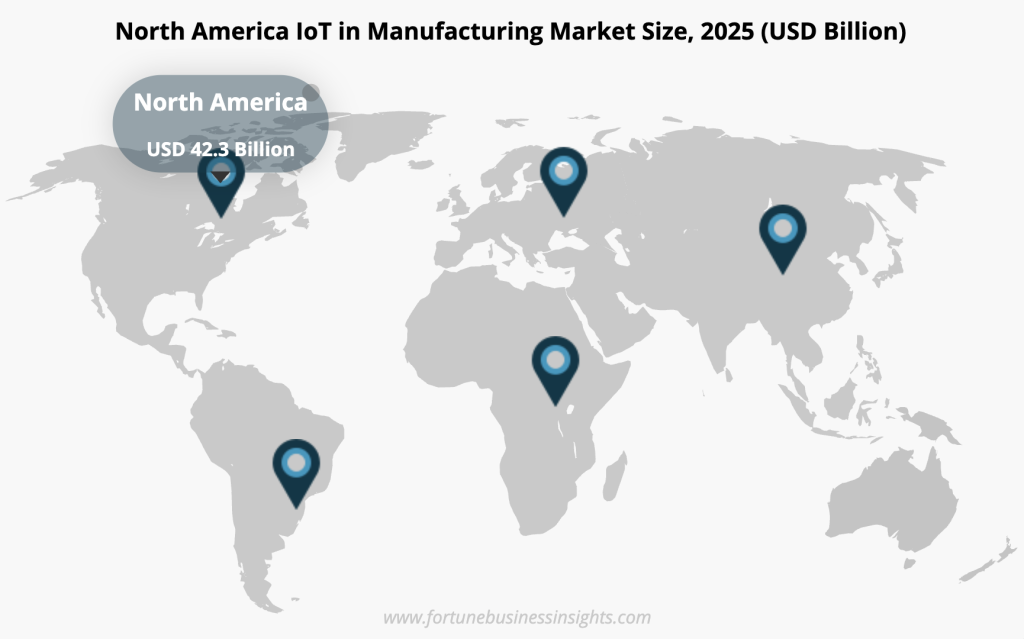
North America was the largest regional IoT in manufacturing market in 2025, accounting for 30% of the global market with a value of $42.3 billion. The regional market is projected to reach $51.05 billion by the end of 2026, while the U.S. market alone is expected to total $27.61 billion.
However, Asia Pacific has the fastest-growing market, led by China, Japan, and South Korea. With the second-largest market share in 2025, at an estimated 40.81%, the region is expected to grow at a CAGR of 28.8% by 2034.
2. Nearly half of manufacturers have already deployed and experienced gains from industrial IoT2
Deloitte’s 2025 Smart Manufacturing and Operations Survey, based on responses from 600 manufacturing executives, found that 46% of manufacturers are leveraging the industrial internet of things (IIoT) at the facility or network level.
That adoption runs alongside related technology. About 57% are leveraging cloud computing, the same share are using data analytics, and 42% are using 5G.
Respondents further along the adoption curve reported up to a 20% increase in production output, up to a 20% increase in employee productivity, and up to a 15% increase in unlocked capacity from IoT-enabled sensing, automation, and analytics.
These are self-reported figures, so they’re directional rather than universal, but the consistency across output, productivity, and capacity is notable.
3. Unplanned downtime costs the world’s biggest manufacturers $1.4 trillion a year3
Unplanned downtime costs Fortune Global 500 companies a combined $1.4 trillion annually, equivalent to 11% of their total revenue, according to Siemens’ 2024 True Cost of Downtime report.
The average large plant loses 27 hours a month to unplanned stoppages and experiences roughly 25 downtime incidents a month.
For example, the automotive sector loses $695 million per year due to idle production lines at big plants. That’s about $2.3 million per hour or $600 per second. This is a 150% increase over a five-year period.
Meanwhile, heavy industry plants lose around $59 million per year, a 160% increase over five years.
The combination of cost per incident and persistent frequency is the financial case driving manufacturers toward connected sensors and predictive analytics, since the goal of most IoT deployments on the factory floor is to catch a failure before it turns into a stoppage.
4. Predictive maintenance is the largest and fastest-growing application, at 30% of the market1
By application, predictive maintenance is projected to hold the largest market share in the IoT in manufacturing market in 2026, at 30.22%, according to a report by Fortune Business Insights. This is also the highest CAGR of any application segment.
IoT sensors and analytics let manufacturers monitor equipment performance and help them predict failures before they happen. This reduces unplanned downtime and repair costs. Asset tracking and management, and logistics and supply chain coordination, trail behind as the next most common uses.
5. GenAI adoption at the world’s most advanced factories nearly tripled in a single year4
Among 223 sites in the World Economic Forum’s Global Lighthouse Network, generative AI accounted for 23% of manufacturers’ top five deployed use cases in 2025. This was up from 9% in 2024. This data comes from the Forum’s January 2026 white paper.
The more established category, analytical AI and machine learning, is already embedded in 62% of top use cases.
None of this AI runs without IoT underneath. These AI systems draw on real-time data from connected sensors and machines, and the report notes that GLN sites have connected an average of 85% of their production and logistics endpoints to unified IT and OT systems to make data usable at scale.
Common questions about IoT in manufacturing
How big is the IoT in manufacturing market projected to grow?
Fortune Business Insights projects the market will reach $1.108 trillion by 2034, up from 141.18 billion in 2025 at a CAGR of 26.20%. North America, including the US and Canada, dominates with 30% market share at $42.3 billion. If North America holds its market share, the US and Canadian market will reach $332.4 billion by 2034.
How much does unplanned downtime cost manufacturers each year?
Fortune Global 500 companies lose a combined $1.4 trillion per year to unplanned downtime, equivalent to 11% of their total revenue, according to the True Cost of Downtime report from Siemens AG.
What percentage of manufacturers actually use IoT today?
Around 46% use industrial IoT at the facility level, according to Deloitte’s 2025 survey of 600 manufacturing executives. The majority of the industry has not yet deployed it plant-wide.
Does IoT adoption actually improve output?
Manufacturers self-report up to 20% gains in production output and employee productivity, and up to 15% in unlocked capacity. These figures come from surveyed executives rather than independently audited results.
What is the biggest use case for IoT in manufacturing?
Predictive maintenance, which holds roughly 30% of the market and is growing faster than any other application, according to Fortune Business Insights. This is followed by asset tracking and management, then logistics and supply chain management, with real-time workforce tracking and management and emergency and incident management rounding out the ranked list.
How fast is AI adoption growing in manufacturing?
Generative AI now accounts for 23% of top use cases at Global Lighthouse Network factories worldwide, up from 9% the year before, according to the World Economic Forum’s January 2026 white paper. In the US specifically, manufacturing posted the fastest year-over-year growth in work-related generative AI adoption of any major industry tracked, up about 58%, according to an April 2026 Federal Reserve staff note.5
How Modularis Can Help
Modularis is the maker of PlatformBuilder, a modular AI code generation platform that accelerates serious IoT development.
Whether you’re developing systems for predictive maintenance, connected production lines, plant-wide asset tracking, or smart factory monitoring, PlatformBuilder allows you to build and test software before the hardware is finalized. Avoid costly system failures and catch issues before deployment.
With over 500,000 IoT devices supported and over $285 million in exit value created, we solve the biggest challenges in IoT software development, not only for manufacturing but also for IoT in energy, IoT in healthcare, and other industries. Contact us to schedule a brief demo today.
Sources
- https://www.fortunebusinessinsights.com/industry-reports/internet-of-things-iot-in-manufacturing-market-101677
- https://www.deloitte.com/us/en/insights/industry/manufacturing-industrial-products/2025-smart-manufacturing-survey.html
- https://assets.new.siemens.com/siemens/assets/api/uuid:1b43afb5-2d07-47f7-9eb7-893fe7d0bc59/tcod-2024_original.pdf
- https://reports.weforum.org/docs/WEF_Global_Lighthouse_Network_2026.pdf