
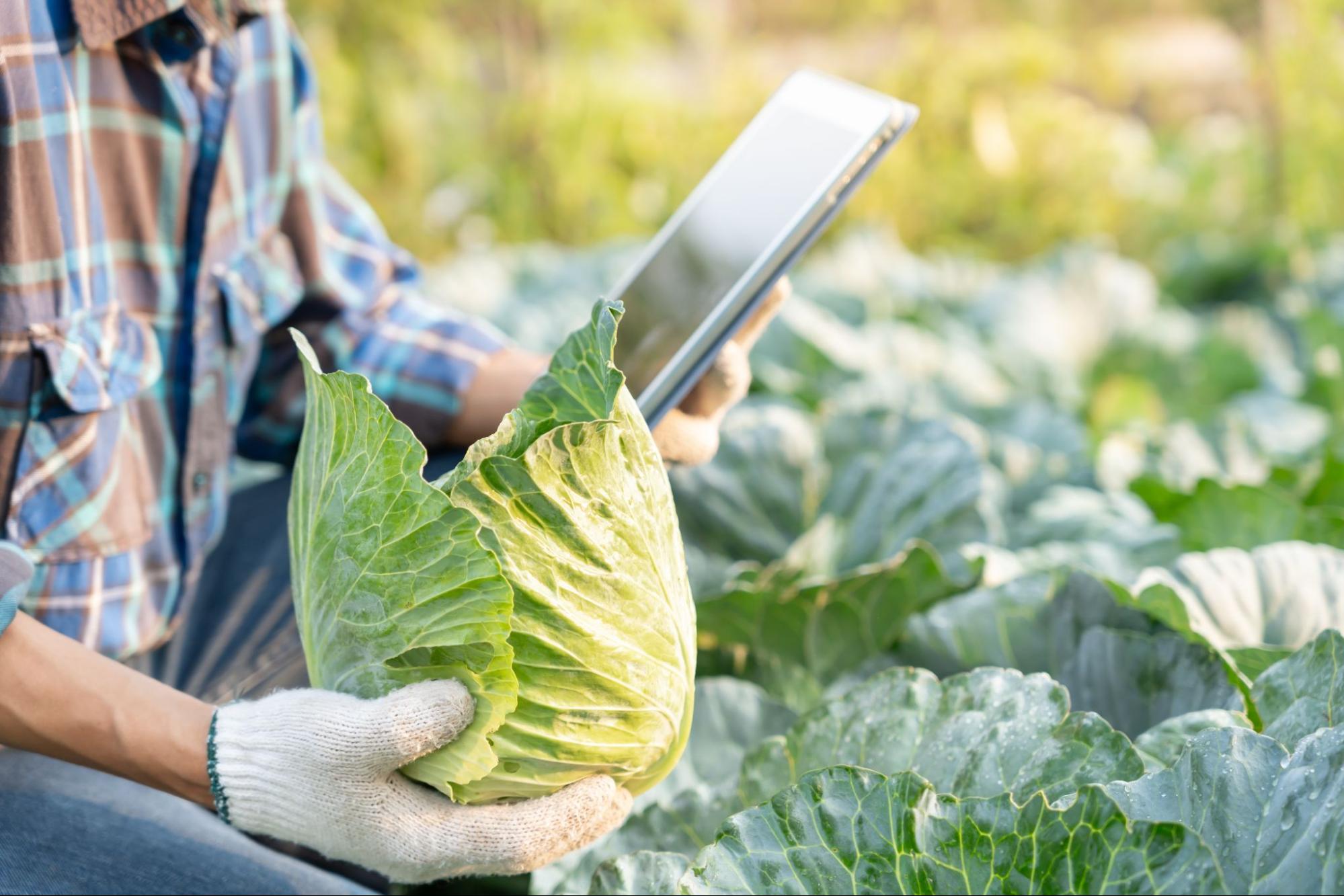

IoT in agriculture allows farmers to optimize agricultural practices by leveraging connected devices and data analytics. Farmers can remotely monitor crop conditions, livestock health, weather conditions, and water usage, while automating processes like irrigation, equipment tracking, and supply chain management.
According to a 2025 report released by the UN, 2.3 billion people experienced some form of food insecurity. Estimates project agricultural production will need to increase 60% to 110% by 2050 to feed the global population, making smart farming solutions that maximize crop yields increasingly important to the future of agriculture.
At Modularis, we’ve gathered essential IoT in agriculture statistics and trends that provide insight into the benefits, applications, challenges, and use cases for the Internet of Things in agriculture.
3 Easy Steps to Make Modularis Your Trusted Partner
Our on-boarding process engages your entire organization in a staged process that aligns technical milestones with your business objectives. Learn what you need to get started today!

IoT in Agriculture – Key Statistics
1. The global IoT in agriculture market is projected to more than double by 2034, growing from $19.5 billion in 2026 to $40 billion
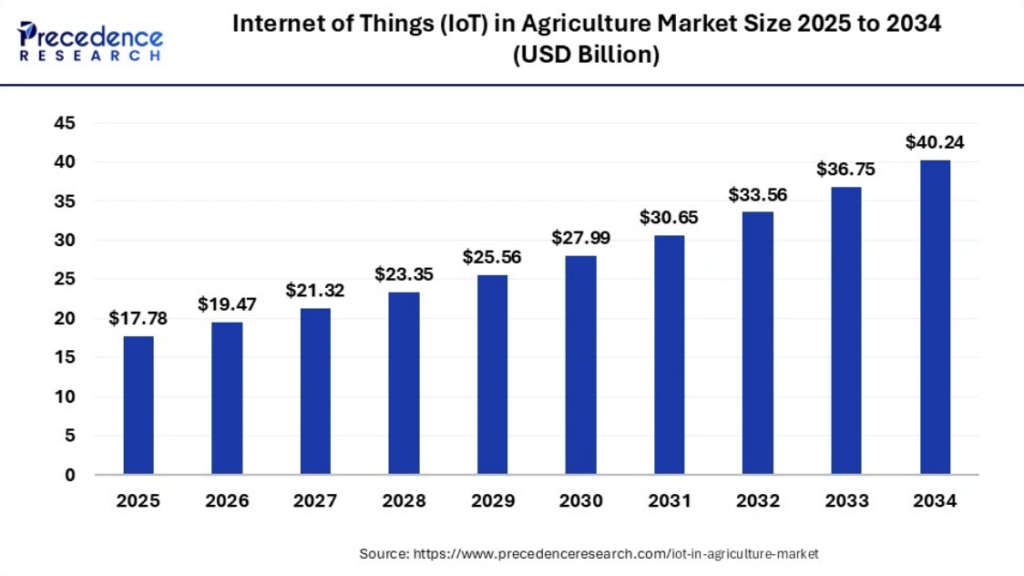
Image Source: Precedence Research9
The global IoT in the agriculture industry is valued at an estimated $19.47 billion in 20261, up from $17.78 billion in 2025. The market size is projected to expand rapidly over the next eight years, reaching $40.24 billion in 2034 at a compound annual growth rate (CAGR) of 9.37%.
The following are the projected global market sizes in 2034 in select segments:
- Monitoring technologies: $8 billion
- Smart sensor systems: $3.2 billion
- Agriculture drones: $2.21 billion
2. Asia Pacific region leads with 44% of the global IoT in agriculture market size
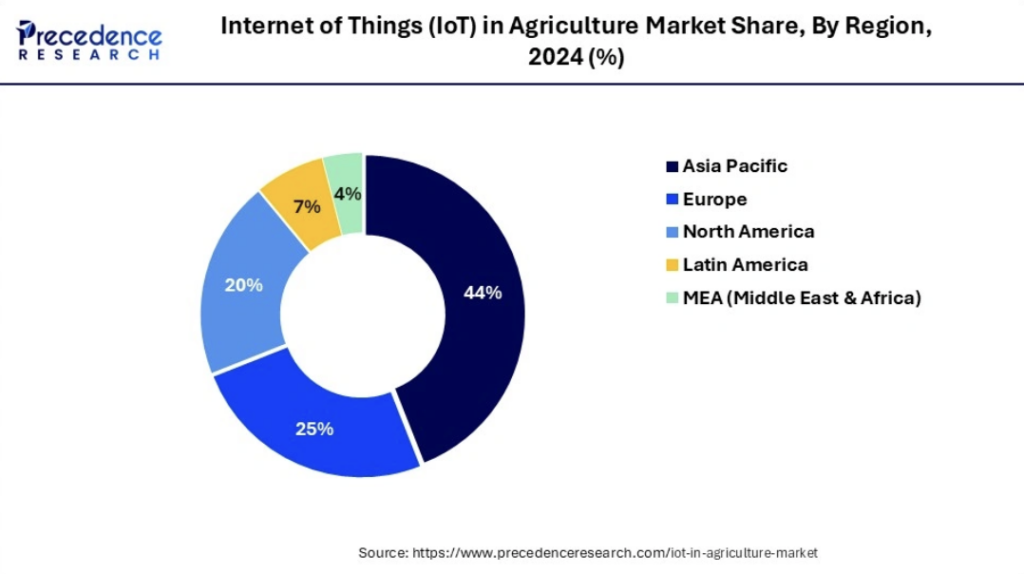
Image Source: Precedence Research9
According to the latest IoT in agriculture statistics from 2024, the Asia Pacific region represented 44% of the market size1, followed by Europe with 25%, North America with 20%, Latin America with 7%, and the Middle East and Africa (MEA) with 4%.
The Asia Pacific market size was $8.57 billion in 2025 and is projected to grow to $19.42 billion by 2034 at a 9.52% CAGR.
3. Farmers are using nearly 100 million connected devices
As of the most recent data from 2024, farmers were already using nearly 100 million connected devices2. This number has certainly increased since then and is projected to continue growing as farmers adopt smart agriculture technologies like sensors, drones, and smart machinery.
Additional IoT in Agriculture Statistics
1. American farmers use digital guidance for over 50% of acreage devoted to essential crops
According to the USDA, more than half3 of the acreage growing cotton, corn, sorghum, rice, winter wheat, and soybeans in the U.S. leverages some form of automated assistance. This follows a steep increase in usage over the past two decades.
2. IoT solutions can identify and remove weeds with up to 98% accuracy
Numerous case studies highlight the effectiveness of IoT applications in weed control. One project leveraging machine learning technology was able to identify weeds with up to 98% accuracy4 and remove them using tines or sparks.
Meanwhile, a project using a segmentation algorithm and an RGB camera was able to identify weeds with 96% accuracy2.
Another project used a camera attached to an ATV to identify weeds and apply herbicide with up to 78% precision2.
In other efforts to avoid using chemicals for weed control, one provider uses IoT-enabled robotics to destroy weeds with lasers2.
3. Remote sensing technologies can identify healthy produce with up to 89% accuracy
Researchers used hyperspectral sensors and data analysis to identify diseases in sugar beet leaves with 85% accuracy and higher5. These precision agriculture and remote sensing technologies, which are often used in IoT applications, identified healthy leaves with 89% accuracy5.
The following are the accuracy rates for identifying specific diseases5:
- Cercospora leaf spot: 92%
- Sugar beet rust: 87%
- Powdery mildew: 85%
An average of 30% of harvests are lost to pests and diseases2. Reducing this percentage with IoT-powered agriculture solutions can help farmers identify diseases early and take action to protect crops.
4. Smart farming solutions can identify produce quality with up to 96% accuracy and ripeness with over 98% accuracy
Using audio signal processing and an artificial neural network, farmers were able to sort hazelnuts based on size with 96.1% accuracy6, as well as identify them as hollow (89.3% accuracy) and damaged (93.1% accuracy).
Meanwhile, precision farming techniques using hyperspectral imaging and a convolutional neural network were able to classify early ripe and ripe strawberries with 98.6% accuracy7. This allows farmers to optimize harvest times, increasing yield and reducing spoilage.
Other programs have used artificial intelligence to identify bunches of grapes with 75% accuracy2 for accurate yield predictions and combine AI with a robotic arm to pick ripe tomatoes with 89% success2.
5. IoT sensors can help reduce water use by up to 50%
Smart irrigation systems can analyze soil moisture with real-time data to deliver the precise amount of water needed to areas that require irrigation.
In a study involving tomatoes, smart irrigation also reduced farmers’ working hours by 25%8 and improved the quality of the produce, allowing farmers to increase prices by 20%8 compared to the previous year.
Advancements made possible by IoT in agriculture can not only help reduce costs and working hours while increasing crop quality and profitability, but also improve sustainability, help protect the ecosystem, and fight climate change.
How Modularis Can Help
Modularis is the maker of PlatformBuilder, a modular AI code generation platform that accelerates serious IoT development.
Whether you’re developing systems for smart irrigation, smart greenhouses, livestock monitoring, or precision agriculture, this PlatformBuilder allows you to build and test software before the hardware is finalized. Avoid costly system failures and catch issues before deployment.
With over 500,000 IoT devices supported and over $285 million in exit value created, we solve the biggest challenges in IoT software development, not only for the agricultural sector but also for IoT in healthcare and other industries. Contact us to schedule a brief demo today.
IoT in Agriculture – FAQs
What are the benefits of IoT in agriculture?
IoT technology enables smart agriculture solutions that allow farmers to remotely monitor crop health, soil conditions, nutrient levels, crop diseases, pest infestations, and livestock health.
Farmers can leverage real-time data collection to make informed decisions to optimize resources and maximize crop production, profitability, and scalability. Meanwhile, IoT technology empowers them to reduce labor needs, food insecurity, and the environmental impact of farming operations. For example, IoT sensors can optimize irrigation and minimize herbicide and pesticide use.
How can the Internet of Things be used in agriculture?
IoT in agriculture can optimize or automate a wide range of farming practices, including crop monitoring, livestock monitoring, smart irrigation, smart greenhouses, precision pest control, supply chain optimization, farm equipment monitoring, and yield monitoring and prediction.
IoT connectivity allows sensors to collect data in real time, allowing farmers to make data-driven decisions for precision farm management.
What are smart farming technologies?
Smart farming technologies include sensors and other monitoring equipment, automation systems, and robotics, including autonomous tractors and unmanned aerial vehicles.
These technologies leverage AI, data analytics, and machine learning to optimize farming practices and allow remote crop and livestock management via smartphones, tablets, and other connected devices.
Farmers can monitor crop growth, soil quality, livestock health, irrigation, and weather stations for IoT-enabled decision-making while remotely managing automated systems.
What are the challenges facing IoT in agriculture?
While IoT is delivering significant advancements in the agricultural sector, one of the leading challenges is data transmission in rural areas. Reliable connectivity is essential for IoT in agriculture, and developing rural networks may be a barrier to adoption in remote areas.
Additionally, large-scale data storage, security, and analysis can require specialized help from a third party. Scaling and supporting hardware and infrastructure can also present financial hurdles for smaller farming operations.
However, with planning and strategic investments, IoT technology offers a bright future for agribusiness.
Sources
1. https://www.precedenceresearch.com/iot-in-agriculture-market
2. https://www.informationweek.com/machine-learning-ai/ai-and-iot-are-reshaping-agriculture
3. https://www.ers.usda.gov/publications/pub-details?pubid=105893
4. https://www.sciencedirect.com/science/article/abs/pii/S0168169918304836
6. https://www.mdpi.com/2076-3417/10/9/3315
7. https://www.sciencedirect.com/science/article/pii/S2589721720300131
8. https://www.sciencedirect.com/topics/agricultural-and-biological-sciences/support-vector-machine
9. https://www.precedenceresearch.com/iot-in-agriculture-market