Modularis

Product Launch #45

Unifying 80 legacy systems into one platform… still creating value 10+ years later

Happy businesswoman and her colleagues working on desktop PC in a call center.

This project was set up to fail

When Modularis engaged with what is now Alvaria, the problem went beyond modernization – the company was thinking in terms of survivability.

Through a series of acquisitions, the company had inherited 80 separate call-center applications across Rockwell, Concerto, and Aspect environments. Each system had its own technology stack, data model, configuration workflow, and customer base. Customers were not willing to migrate, and forcing them to would have been commercially disastrous.

The result was an operational dead end.

Simple configuration changes required switching between multiple clients, manually copying settings, and reconciling inconsistencies across platforms. Every update introduced risk. Every new customer increased complexity. Scaling the business without breaking existing environments was effectively impossible.

Internally, expectations were low. Unifying dozens of incompatible, mission-critical systems (without rewriting them or disrupting customers) was widely seen as unrealistic. The mandate was clear and unforgiving:

  • Preserve each existing platform
  • Eliminate configuration chaos
  • Provide a single control point across all systems
  • Deliver something that could actually be maintained long-term

Modularis approached the problem as an architectural one. Instead of replacing systems, the team designed a Unified Command & Control (UCC) platform – a translation and orchestration layer capable of normalizing configuration, managing workflows, and coordinating behavior across all 80 back-end systems.

“Modularis was able to solve that because we had a unified configuration client which could talk to all the back-end call centers and do the configuration.”

alvaria-logo
Bis Mukherjee
Sr. Manager, R&D

Young consultant with beard wearing headset smiling cheerfully and listening to customer in call center

One control plane for 80 incompatible systems

The Unified Command & Control (UCC) platform orchestrates the Aspect, Rockwell, and Concerto systems. Modularis designed UCC as a translation and normalization layer that sits above each call-center platform, abstracting their differences while preserving their native behavior. Configuration changes are modeled once and then reliably propagated to the appropriate underlying systems.

This approach eliminated manual copy-and-paste workflows and ensured consistency across mixed-vendor environments, even when customers run multiple platforms in parallel. UCC gives customers a single point of control for reporting, routing, administration, and workflow management, while Modularis handles the complexity beneath the surface.

The biggest win here is that the platform simply doesn’t force migration.

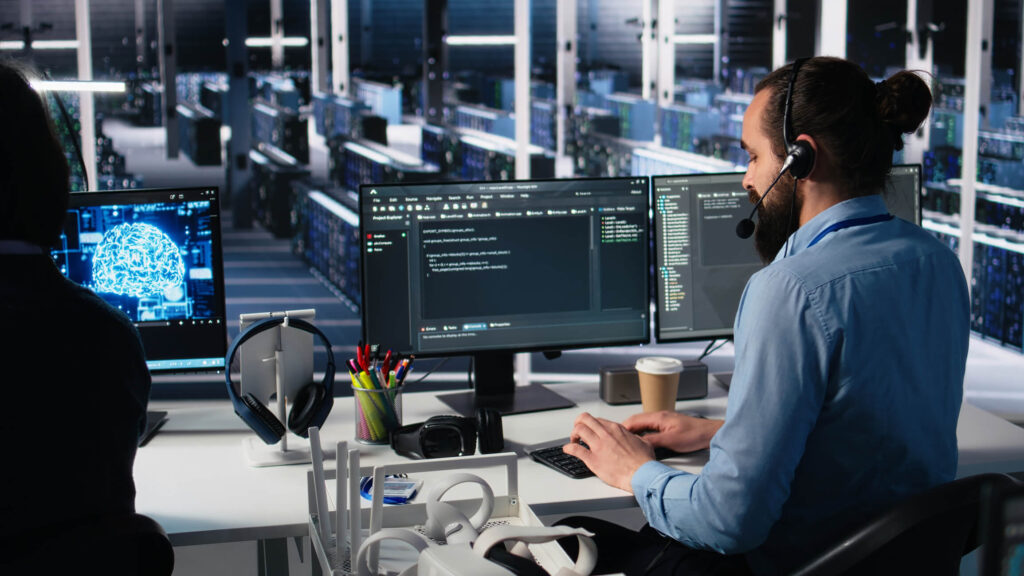
Data center admin using AI assistant to provide user technical support and solutions to users. Server farm IT expert managing live support calls assisted by artificial intelligence chatbot, camera A

70% code automation to compress delivery timelines

A unification effort of this scale can take years… Modularis reduced that timeline by changing how the system was built.

Our team modeled the domain instead of hand-coding each integration, generated the majority of the codebase automatically, and focused engineering effort only on what was truly unique. Roughly 70% of the code was generated, not written manually.

“If we had done it by hand, it would have taken months.”
alvaria-logo
Bis Mukherjee
Sr. Manager, R&D

This approach compressed delivery dramatically. UCC 1.0 shipped in under six months, fast enough to earn internal confidence and external recognition, while maintaining stability across dozens of live systems.

call center worker

Built to survive change well beyond launch

UCC was designed with one assumption: everything around it would change.

Over time, the platform outlived product roadmaps, leadership teams, and even company names, moving from Rockwell FirstPoint to Concerto, then Aspect, and now Alvaria. Throughout those transitions, the underlying call-center systems evolved independently, yet UCC remains stable.

That durability comes from architectural separation. By isolating translation, configuration, and orchestration logic from the underlying platforms, Modularis ensured that change could be absorbed without cascading failures. New systems could be introduced, existing ones modified, and legacy environments maintained, all without destabilizing the control layer.

The result was a platform that resisted entropy. Instead of accumulating brittle integrations, UCC continues to operate as a reliable control plane, supporting mixed environments long after most enterprise modernization projects would have required a rewrite.

This is what future-proofing looks like in practice: not predicting what will change, but designing so change doesn’t matter.

Shot of call center operators working in the office. Call center agent working with his colleagues in modern office. Smiling handsome businessman working in call center.

10+ years in production: Still stable, still valuable

More than a decade after launch, UCC is still in production… stable, supported, and generating revenue.

That outcome reflects deliberate architectural decisions and an embedded partnership model that prioritized long-term serviceability over short-term delivery. Modularis worked alongside Aspect’s R&D team, transferring knowledge, resolving integration complexity in real time, and reducing delivery risk as the system matured.

“They work with us like they are our partners. They get embedded in the team and work with us to solve our use cases.”
alvaria-logo
Bis Mukherjee
Sr. Manager, R&D

The results were measurable:

  • The highest product-quality score of any Aspect product shipped
  • Internet Telephony Magazine “Product of the Year”
  • ROI achieved in three months

As the organization evolved into Alvaria, the platform endured. UCC continues to operate across mixed environments without rewrites, serving as a durable proof point of the Modularis model: software designed to remain stable, scalable, and supportable for decades.

This is not a modernization story. It’s evidence that the right architecture – built once – can keep delivering value long after expectations expire.

"Modularis has been a terrific strategic partner for us.They have the leadership, experience, discipline, and technology we needed to build and grow our global IoT platform."

Nick Mirchef, President, SmartWitness

Nick Mirchef

President

icon - quote

“If we had built it by hand, it would have taken months. Modularis saved us 70% of the coding. We only had to write 30%. That’s why we were able to move so fast.”

icon - quote
Picture of Bis Mukherjee

Bis Mukherjee

Sr. Manager, R&D

UNMATCHED VALUE

Value isn’t determined by what software
can do, but by how well it does it.

Microsoft Gold Partner logo

We collaborate closely with Microsoft and are proud to have earned the highest standards of Microsoft’s widely-recognized partnership program.