


Technical debt is the hidden cost of maintaining and extending software that was built faster than it was built well. It includes shortcuts, missing tests, and outdated design decisions that make future changes slower, riskier, and more expensive.
A simple example: a retail app stores every price as a plain number because it only sells in U.S. dollars. When the business expands to Canada, every price field, calculation, and report that assumed one currency has to change. That rework is the technical debt.
Every software development team carries some. A deadline moves up, a quick fix ships, a test gets skipped, and the product keeps working. The cost shows up months later as slower releases and features that take three times longer than anyone estimated. Good teams plan for it instead of discovering it during an outage.
3 Easy Steps to Make Modularis Your Trusted Partner
Our on-boarding process engages your entire organization in a staged process that aligns technical milestones with your business objectives. Learn what you need to get started today!

Where the term technical debt comes from
Ward Cunningham coined the term in a 1992 experience report for the OOPSLA conference. He needed a way to explain to the finance-minded leadership at Wyatt Software why his team kept refactoring code that already worked.
He borrowed the term from financial debt because his audience understood that language. The debt metaphor made one point: shipping code before you fully understand the problem is reasonable, as long as the team rewrites it once it learns more. The trouble starts when that rewrite never happens.
Martin Fowler later added the technical debt quadrant, which sorts debt by two questions. Did the team take it on deliberately or by accident? And was the decision prudent or reckless?
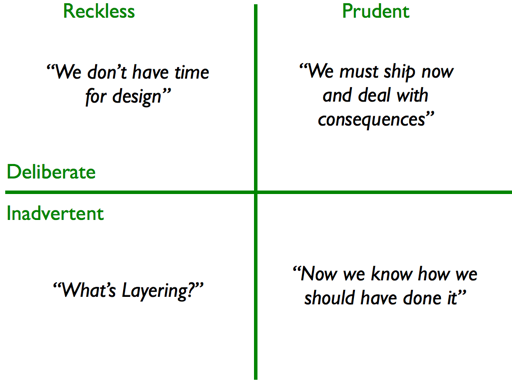
Intentional, prudent debt can be a reasonable trade-off when a team understands the consequences and plans to address them. Reckless debt, whether deliberate or inadvertent, arises when teams take shortcuts without adequately considering their consequences.
The main types of technical debt
Technical debt is not one thing. Most software development teams carry several kinds at once, and each kind needs a different fix.
- Code debt: Duplicated logic, unclear naming, quick fixes left in place, and code complexity that grows with every workaround.
- Design debt and architecture debt: Tightly coupled components, a monolithic architecture that fit version one but blocks the current roadmap, and interfaces that expose internals.
- Test debt: Missing or unreliable automated testing. Every change becomes a manual verification task, and bug fixes break things nobody checked.
- Documentation debt: Decisions that live only in someone’s head. New developers reconstruct them by reading code, and the knowledge leaves when they do.
- Infrastructure debt: Outdated dependencies, unpatched servers, and build pipelines only one person understands. Many security vulnerabilities start here.
- Process debt: Skipped code reviews, no coding standards, and tickets nobody prioritizes.
What causes technical debt
Deadline pressure is the most common cause. The release date is fixed and the scope is not, so the team ships quick fixes and workarounds and files a cleanup ticket that drops to the bottom of the backlog the moment the next deadline appears.
Turnover turns ordinary code into legacy code. When the people who built a system leave, the people who remain add layers around it rather than change it.
AI coding tools are a newer cause. Code now arrives faster than teams can review it, a pattern covered in our article on the technical debt of AI code.
The cost of technical debt
The cost of technical debt shows up in developer time first. In Stripe’s 2018 Developer Coefficient survey, developers reported spending an average of 13.5 hours a week on technical debt and another 3.8 hours fixing bad code, close to 42% of an average 41-hour week.
At the company level, McKinsey’s 2020 survey of 50 CIOs found that 10% to 20% of the budget meant for new products goes to resolving tech debt instead, and that tech debt amounted to 20% to 40% of the value of their entire technology estate.
at large financial-services and technology companies.
The risk side is harder to quantify. Legacy systems with no test coverage fail in production, outdated dependencies become security vulnerabilities, and maintenance costs climb while the roadmap slips.
How to measure technical debt
Most technical debt stays invisible until a two-day feature takes two weeks.
Code quality tools such as SonarQube score code complexity, duplication, test coverage, and code smells, and some translate the results into an estimated remediation time.
Delivery metrics tell the business side of the story. Track lead time for a change, how often releases cause incidents, and what share of each sprint goes to bug fixes and unplanned work.
The simplest measure is a tech debt backlog: every known shortcut logged as a ticket, with the part of the codebase it affects and what it costs the team each month.
How to manage technical debt
The goal of technical debt management is not zero debt. It is deciding on purpose which debt to carry and which to fix:
- Put it in the backlog: Technical debt that lives in a wiki or in one developer’s memory never gets scheduled. Log it as tickets and prioritize it against features.
- Reserve capacity: Scrum teams often hold 10% to 20% of each sprint for refactoring and other technical debt work. The exact share matters less than protecting it when a deadline appears.
- Fix as you go: Refactoring the code you are already changing costs far less than a dedicated rewrite project, and it keeps maintainability from sliding.
- Automate the checks: Automated testing, static analysis, and code reviews on every change catch new debt before it merges.
- Agree on coding standards: One shared standard is cheaper than reconciling five styles later.
For a practical, step-by-step approach, learn how to reduce technical debt.
How AI-generated code compounds technical debt
AI coding tools do not create a new kind of technical debt. They create the old kinds faster than teams can review them.
GitClear’s June 2026 analysis of 623 million code changes found refactoring fell from 21% of changed lines in 2022 to 3.8% in 2026, while duplicated code blocks rose 81% from their 2023 level. Veracode found that 44% of tested AI code generation tasks produced code containing a known security vulnerability.
Documentation debt grows too. When nobody on the team wrote the code, nobody holds the reasoning behind it. Margaret-Anne Storey calls this cognitive debt, the erosion of shared understanding about how a system works and how it can be changed. She argues that it may become a greater risk than technical debt as AI adoption grows.
The remedies are the ones above, applied with more discipline: measure code structure rather than output volume, run tests and security scans on every AI-assisted change, and make sure one person understands each change before it ships.
How Modularis helps teams manage technical debt
Most technical debt comes from building fast without a process that protects code quality. AI code generation on its own makes software development faster, not better.
Modularis 19, a modular AI code generation platform for commercial products, is built around that problem. Deterministic, model-driven generation produces the structural foundation, roughly 80% of the code, and LLMs help engineers with the customer-facing 20%. The result is a stable, serviceable codebase rather than another layer of unreviewed output on an old one.
For products that already carry heavy debt, the Tech360 Assessment maps what exists and what it will cost to fix, and Modularis architects transfer their knowledge to your engineers at no extra cost, so your team stays self-sufficient.
Over 26 years, Modularis has launched 79 products with zero failures, supported more than 500,000 IoT devices, and created over $285 million in exit value.
Book a demo to see how Modularis 19 fits your roadmap.